UNDERSTANDING SOCIAL ANXIETY
Why does a simple conversation take so much effort?
You can notice that you’re rewriting a message and still sit there rewriting it. Or know you’re waiting too long to speak, then watch the moment pass again.
Understanding Social Anxiety looks at how habits like these can develop, with small practices for the moments you’d like to handle differently.
Digital book + companion guide + worksheets $29 60-day guarantee
HOW A HABIT CAN BECOME FAMILIAR
Sometimes the pause starts with a small rule.
Maybe you asked a question and were told it had already been explained. Next time, you checked first. Then you started checking even when nobody had given you a reason to.
Or you got used to waiting for other people to speak. After a while, waiting felt easier than working out how to join in.
You might not remember when you started doing it. You just know it’s become the usual way you get through a conversation. The book looks at how these responses can be learned, why they keep showing up, and what you can practice when they get in the way.
“I should already know.”
“I’ll wait for a better opening.”
“Let me make sure it sounds right.”
A simple question.
A lot happening before you ask it.
WHAT A DIFFERENT RESPONSE CAN LOOK LIKE
The question you nearly didn’t ask.
You’re a few weeks into a new job. Someone asks you to update a spreadsheet before a meeting. You open the file. There are two tabs, and you’re not sure which one they mean.
THE FAMILIAR RESPONSE
“They’ve already explained it. What if they think I wasn’t listening?”
So you search old emails and open last month’s file. Half an hour passes. Now you’re worried they’ll ask why it’s taking so long.
You needed one piece of information. Trying to look capable made it harder to get.
This is the kind of small, specific practice the book explores. You can start with a question you want to ask, a message you want to send, or a moment you’d like to join.
A LOOK INSIDE THE BOOK
Something to try when “just be confident” doesn’t help.
The book follows the moments before, during and after a conversation: the words you check, the openings you miss, and the exchanges that follow you home.
Alongside those examples are small practices, reflection questions and ways to choose a next step. This page is one example. It begins with an ordinary sentence, rather than asking you to change everything at once.
See the book and what comes with itStart with the part you recognized.
There’s more than one place to begin.
The Moment Between Thought And Speech
The Smallest Useful Shift
Look at what happens between having a thought and saying it. Then explore how to choose one manageable response to practice, instead of waiting until you feel completely ready.
Why The Conversation Follows You Home
When Progress Gets Messy
Explore the difference between learning from an exchange and reviewing it again and again. There’s also a chapter about making sense of awkward attempts without treating them as proof you should stop trying.
The Avoidance That Happens Quietly
When Careful Became Identity
Look at the small ways you can step back while still being in the room. The book distinguishes choosing quiet because you want it from holding back when you wanted to take part.
When part of your attention
is on how you appear.
The book examines checking and holding back in ordinary social moments. Its quick practice guide includes “Reduce One Layer,” one of several ways it invites readers to explore a smaller change.
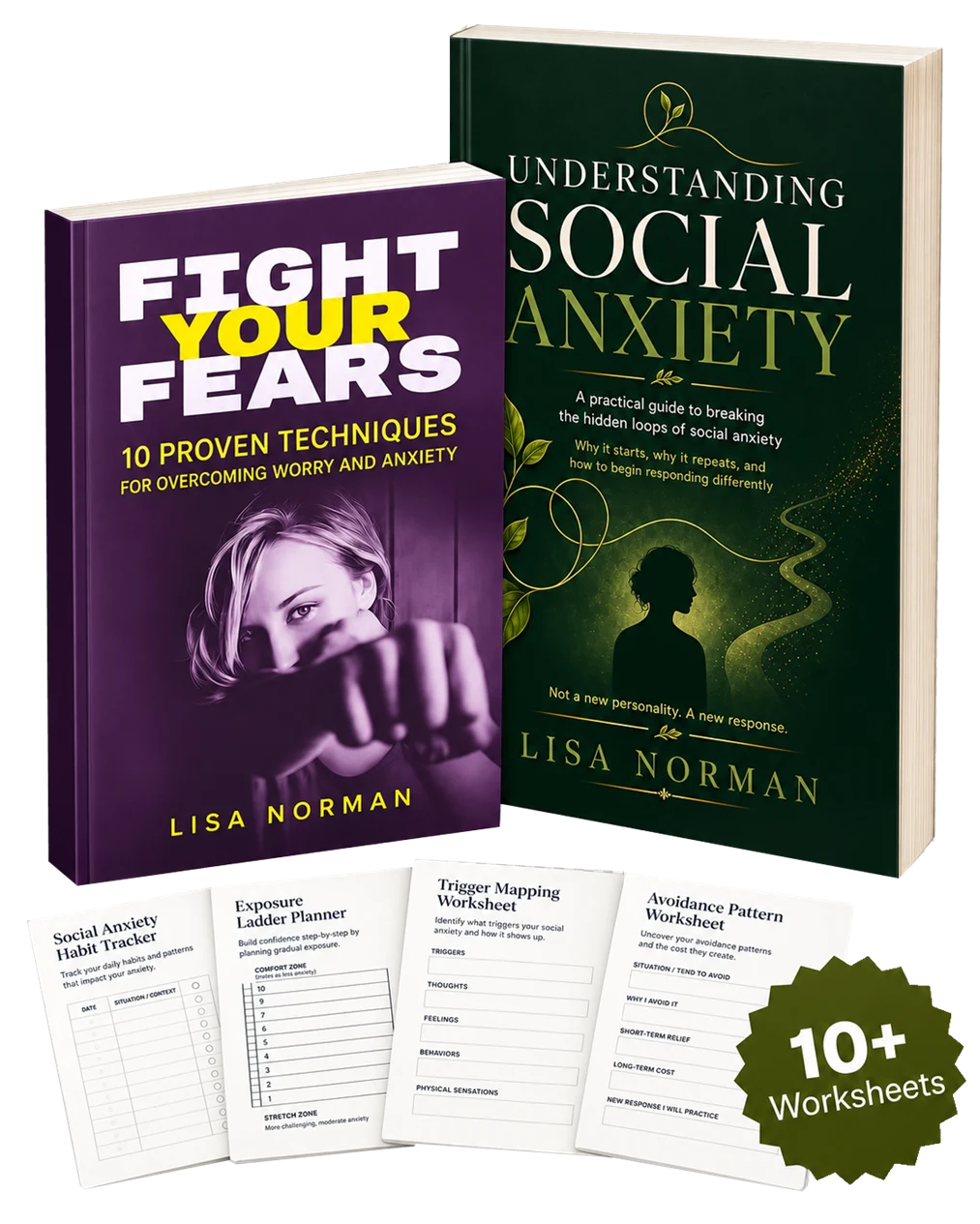
Digital downloads. The book images are illustrative mockups.
YOUR COMPLETE READING & PRACTICE SET
Read about the moment.
Choose what to practice.
Understanding Social Anxiety
The 267-page digital book, with everyday examples, reflection questions and small practice ideas.
Fight Your Fears
The 55-page companion guide. Explore broader fear and worry, including feared outcomes, what you can control, mindfulness and getting support.
Worksheets to write in and return to
Included worksheets such as Trigger Mapping, the Avoidance Pattern Worksheet, the Exposure Ladder Planner and the Social Anxiety Habit Tracker.
Book, companion guide & worksheets
Instant digital access · 60-day money-back guarantee
ONE PLACE TO BEGIN
Pick one moment you’d like to handle differently.
Maybe it’s the question you keep to yourself. Or the reply that stays in your drafts while you try to get it right.
Start with the part of the book that sounds familiar. Use the worksheets to write down what happened and a response you’d like to practice. You can return to the rest when it’s useful.
Get the reading & practice set$29 · Digital access · 60-day guarantee
What if I’m just quiet?
Enjoying quiet or preferring a smaller group isn’t something you need to change. The useful question is whether you wanted to take part, but kept holding yourself back.
What if I already understand what I’m doing?
Recognizing the habit and knowing what to try in that moment are different steps. The book includes a chapter called “Why Awareness Is Not Enough,” followed by small practice ideas you can explore.
Time to read it and see whether it’s useful.
Your purchase includes the 60-day money-back guarantee.